
Who are we?
St George Foundation charity came about after two individuals started helping a group of children in their free time and with their own money. But as the work grew two charities were born, one in Sierra Leone and one in the United Kingdom which work in partnership. Those two people became a team of people, helped by supporters that care deeply for children’s welfare.
Our Impact
Starting from nowhere in 2004, we have now helped over 11,000 children through our projects.
Almost 3,000 of those have lived with us in our children’s home – that’s the core of our mission. About 200 children stay at our children’s home each year (a mix of long and short term).
We also support hundreds of families annually through community projects.
When the Ebola epidemic ravaged Sierra Leone in 2014 four thousand people died and they left 8,000 orphans. We worked for over 2,500 of those orphans and over 600 lived in our home. We found ourselves in the world’s headlines for doing what so few would do and for the courage it took.
We currently lead a campaign on child welfare and anti-slavery, addressing both the national government and West African (ECOWAS) parliament in 2026.
Our stories
Where did we come from?
The work started with just two people getting together at the end of the 11 year Sierra Leonean civil war, to do as much as they could with just their own efforts and in their free time. Justina (Sierra Leonean) and Philip (British) completely changed their lives and have worked together to this day on what has become a lifelong journey. They met because Philip had been a major donor for a project supporting girls released by rebel troops (the youngest was 11). These girls were being rejected because they were pregnant or had had babies by the rebels. Justina was part of the team doing the work to help them.
But what had horrified and inspired them so much to do this work, was the desperate plight of war orphans, forgotten, abandoned, half-starved and homeless. About 3,000 of them were roaming the streets of Freetown at the end of the war and they were very obvious and begging for food. There was no feeding programme for them, no schooling, nowhere to live, no medical care, no future and many people were preying on them. It was seriously unpleasant to witness innocent children suffering like this.
Daily life was very dangerous, highly stressful and a genuine fight for survival. For the girls – it was even more horrendous because homeless girls are open season and that’s still the case today in the twenty twenties. We are still rescuing shockingly young girls from sexual abuse and exploitation off the streets on a regular basis.
Justina’s and Philip’s initial response started for real in April of 2004 with a group of local volunteers to help. Planning to give a daily meal to some of those children and with just their own money it worked out that they could support 35 of them. By day two they found themselves helping 50 and giving two meals a day. By August of 2004 the rainy season was in full force and the conditions were dreadful with the children’s health clearly suffering. With now 68 children completely relying on them, they rented a house and made a real home for them (the longest had been on the street for 7 years). They deliberately created a family atmosphere and were determined the children should feel they belonged somewhere at last and that people genuinely cared. So all the children became brothers and sisters and all the adult volunteers became their aunties and uncles, and so the ‘St George family’ was created. That is still the case today twenty odd years later; we still operate very much as a family and all the staff are still aunties and uncles.
Years of living on the streets and fighting to survive though had made these children feral and sometimes dangerous. To say we were out of our comfort zones just doesn’t do the phrase justice, and honestly, the urge to just run away was intense sometimes. But for the sake of the children we carried on. However, within weeks of moving into the house the children really settled down and half were able to be placed back in to school in the September and were followed half a term later by the rest. Before 2004 was up we really started focusing on the fact that these children must have relatives somewhere, so with the children telling us everything they could remember we went on the hunt. Over the coming months we found relatives for 67 of them and eventually we did find the 68th child’s family (sadly hardly any parents had survived).
As 2005 rolled on, we waited for the summer school term to end and started reuniting them back with their families. Many of the children didn’t want to go and had settled in really well (and that’s still a problem actually). But as the house emptied we replaced those children with new ones off the street and did the process again and so it carried on; every year that was the cycle until 2014.
This film takes a few minutes to watch and although it was not made by or even for us it captured brilliantly what we were doing in the early years (The number of children mentioned was in 2007 when the film was made). Interestingly Terry, a girl in the film became a Police officer and was one of just 23 female Police officers chosen for a UN mission to support women in the Sudanese civil war… so proud of her!
The charity began to form
Sending that first group of children to school, paying all the fees and buying all the uniforms and shoes and bags etc. was a wake-up call though. We were going to need more money!
Philip hadn’t said a word to anybody at this point (except immediate family). They thought he had gone mad, and not wanting to look like the village idiot he had kept completely silent elsewhere. But realising this seed was starting to grow, Philip decided to share the story and ask for help. The story was finally told at a church service one Sunday and many that heard it started to do just that. Sierra Leone wasn’t on anybody’s bucket list at the end of the war and people were shocked at what Philip had seen and recounted. They were inspired by the fact that he hadn’t just seen something but taken action already and they too wanted to help. Philip was desperately concerned about running out of money with a house full of children to feed and so asked people to give what they could afford but on a monthly basis – and that’s what happened. Twenty odd years later we are still largely funded this way with regular private contributions ensuring that the monthly costs are covered. Just ordinary people that want to help and can’t bear thinking of children suffering if they can do something about it, all joining in to help.
We couldn’t have done it without them and our supporters have been every part of the success story!
Then something massive happened... Ebola
The war had long since passed and things seemed to be running smoothly at last and we could finally relax a bit and it just started to feel that we had this huge and unusual family. But in 2014 another calamity hit. Sierra Leone found itself in the international news for all the wrong reasons as a deadly Ebola epidemic spread across West Africa. And St George found itself at the epicentre of the Sierra Leone outbreak and facing its greatest challenge yet. Our charity was about to become the biggest responder for orphaned children in Sierra Leone - we just didn’t know it yet.
Ebola hit West Africa in 2014 and I think our response was the hardest challenge we ever faced, because by the end of it we were all physically and mentally exhausted. It was literally months of working at maximum capacity, with no idea how bad it was going to get, when it was going to end or even if we were going to lose our whole team and the project collapse. There was never a break at the end to recover and so we just had to carry on with looking after children. And throughout the whole epidemic not a single member of staff in Sierra Leone deserted….in my mind they were all heroic and St George Foundation received a Presidential medal and formal recognition in Sierra Leone.
It was a really tough, stressful and sometimes painful period where the whole team in Sierra Leone did something amazing and their story was in the news all over the world. But by the end we were left mourning the death of two of our team and one of their wives and all three were just in their thirties.
So I want to dedicate this story to Augustine Baker who was probably the bravest person ever. His job involved going into the communities where outbreaks had happened and to rescue the orphans, and to his wife Bundu who caught Ebola from him. Their three children went to live with their grandparents and we have supported them ever since.
Plus Eddie Koroma, who had been the home manager for many years and had been like a father to the children in our care.
This story to be continued………
Media coverage of St George Foundation Ebola work is featured on our Ebola response page.
Day-to-day
Our home works to protect any child living on the streets, rescuing them from modern day slavery, sexual exploitation, physical abuse, abandonment or in danger.
How the money is spent
Pie chart showing how the money is spent in each category: only 1.1% is used for UK admin.
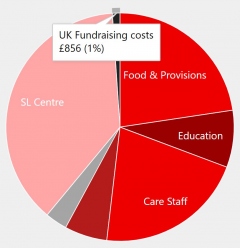
The staff salaries are local to Sierra Leone for staffing the centre, cooks, social workers, etc.
See the full breakdown on our latest financial statements.
